
Making room for new perspectives and more lego.
Well, I am writing to you on my same, old keyboard, but for the first time in a new office, in a new house. Built in 2014, the house is modern, blindingly bright and spans over three floors—basically the exact opposite of the dark loft we’ve been living in for the last 13 years. There’s enough outdoor space that I’ll be craning in a hot tub (that could be a story in itself). The location is also idyllic: Little Italy. The restaurant Divya and I got engaged at is just at the bottom of the street. But the real reason we moved comes down to one Saturday night with bags of Lego and headlamps.
Yes, you read that right. Lego. A hobby that I have purposefully not mentioned to many up to now, but one that I’m finding increasingly ingrained into my life’s narratives. Yes, we’re still talking about lego.
Dviya and I have about a dozen projects finished already, plus three more in our lego cupboard ready for an eventful Saturday night in the near future, and at least 25 more poised in our cart. For any other AFOLs out there, we’ve completed the Vespa, the Mini, F1®, Van Gogh’s The Starry NightVan Gogh’s The Starry NightVan Gogh’s The Starry NightVan Gogh’s The Starry Night, the vintage Polaroid camera, the Trevi Fountain (obviously) and the typewriter.
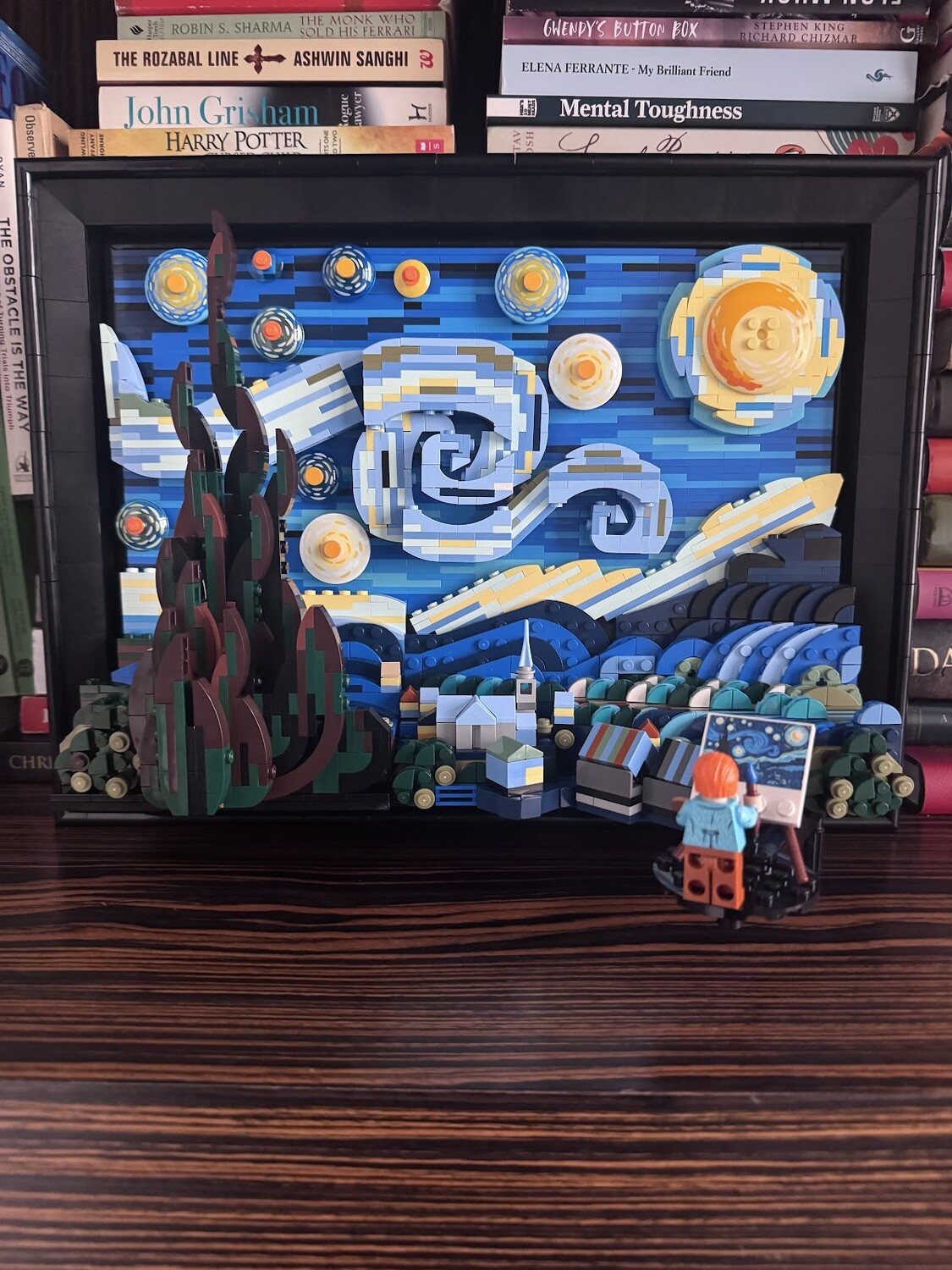
I can’t remember exactly when it started, but now working on one or two bags of Lego each evening has become as routine as an espresso in the morning. No phones, no distractions, sometimes talking, sometimes silently decompressing, Divya and I work on our Lego most evenings before bed. No one is more surprised than us by how deeply invested we are in these little plastic blocks. So much so that we’ve also invested in headlamps. Not following?
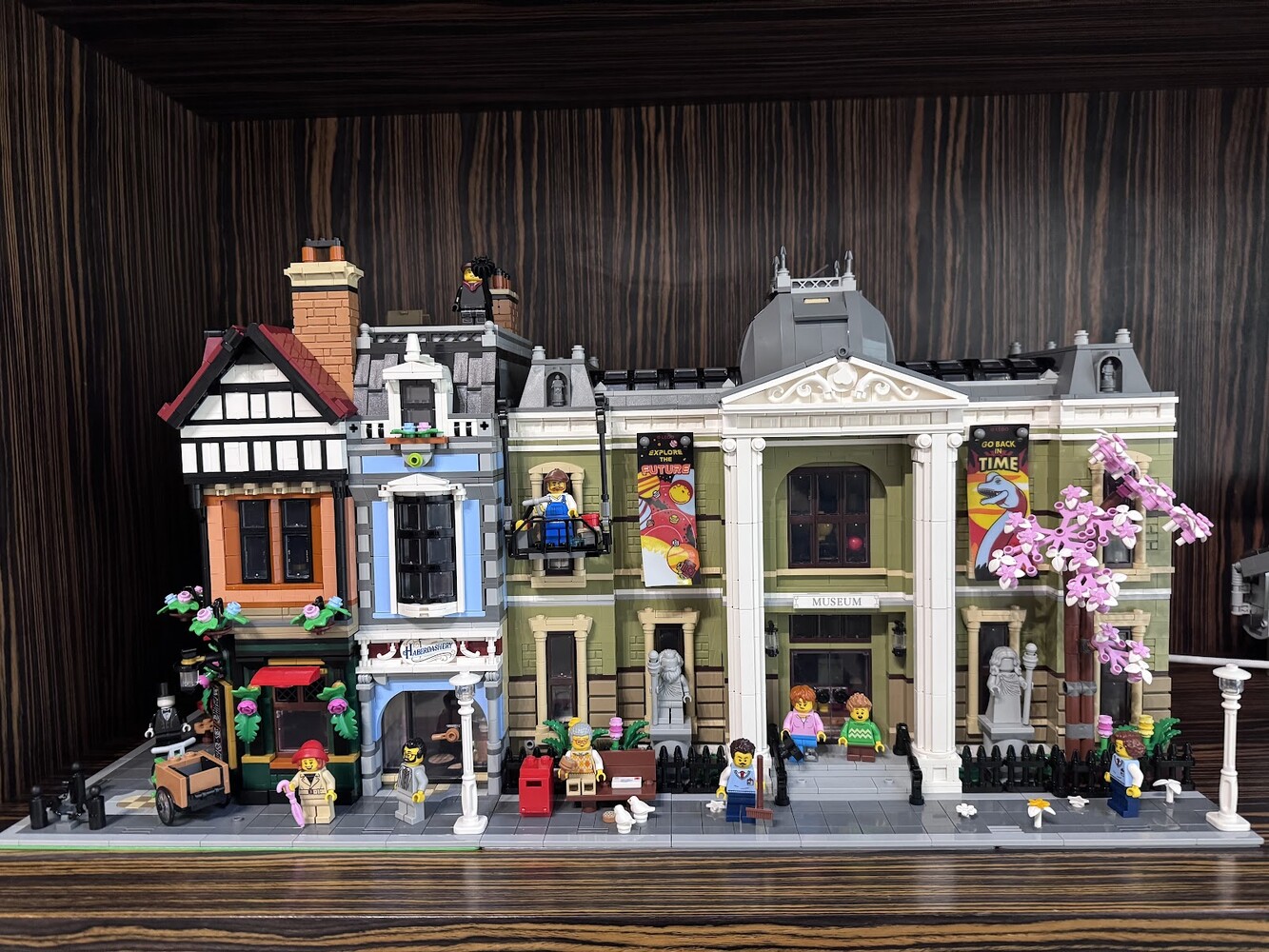
Here’s the thing, we’re old as shit. We literally could not see the pieces.
It seemed like an easy enough remedy to shed light on the problem. But even with extension cords running to our lamps propped around our kitchen island work space, it was still too dark to follow the damn instructions. After some debate, headlamps were ordered on Amazon in time for our next evening’s session.
For the full visual, you have to imagine the vibrant city of Toronto on a Saturday night contrasted with two middle age folks wearing headlamps powerful enough for miners, crouched around a lego instruction manual (that is labelled for ages 18+, thank you very much) when the doorbell rings for DoorDash. We now make a point of reminding each other to ditch the headlamp before answering the door—having already starred in more than one DoorDash delivery story.
Anyways, one Saturday night lego session turned into a HouseSigma session when the extension cords and headlamps just became all too ridiculous. It was either time to invest in additional overhead lighting to our loft (AKA more renovations) or move.
Stagnant Emotions
When moving comes into question, so does a marriott of big, life-altering questions. Where do we see ourselves in the next 5-10 years? Where are we happiest? What do we want out of life? What spaces are we most comfortable in? Who and what do we want to live closest to? Will we be in our same careers the next decade? What are we financially comfortable with?
When these questions all floated into my mind, I made a quick decision that would buy me some more time to figure out the rest. I told Divya, let’s go with new construction. We put down a deposit, signed some paperwork and I wouldn’t have to think about it again for a couple of years. I could just go back to wearing my lego headlamp and ignoring the rest.
The truth is, I was in a very dark place. About a year and a half ago when a project that had me in the UK every few weeks ended, I felt a victim. I could rationalize it, I know why the company made those decisions, but I was still mad. Tantrums were happening in my head. Around that time I seriously considered making a big career change that would have taken me to Dubai. I had a candid conversation with my boss where I told her I’d quit and ultimately, realized the grass isn’t greener.
Truthfully, my unhappiness extended well beyond my professional life. When I was actually confronted with pulling the trigger on any decisions (a new job or moving house), I would always get cold feet. Looking back on it now—six months into weekly therapy—I recognize a lot of this has to do with my inner child. My brain was split between my adult logic and my inner child making emotional, rash decisions based on childhood trauma. Trauma is a heavy word, so I don’t want it to be taken out of context. I had a great childhood, but just like anyone else, the narratives I was told as a child impacts what I do as an adult. I have a good mom, but she gave me trauma the same way yours gave you trauma.
Eye Rolls to Epiphanies
Listen, if I read this six months ago, I would have clicked out at the first mention of an inner child. No time for all that nonsense I would have said. In fact, I had a couple sessions with my current therapist about a year ago and stopped immediately as it felt too spiritual or fluffy. But having opened myself up more (and requesting they keep the spirituality to a minimum) I am enjoying the work. Or at least a lot more than I was at the beginning.
At first, when they had me focus on my breathing during our sessions and my internal dialogue was something along the lines of, “Are you insane? I’m not going to breathe so feel the air in my nostrils.” As testament to how far we’ve come, in a recent session, they had me physically rub my scalp after a particularly emotionally straining conversation. Not only did I follow instructions, but I also felt the full body release of tension. Turns out my therapist knows what they are doing.
We’ve focused a lot of our sessions around dismantling the narrative I had made in my head—one that I’ve written about many times onLinkedIn, particularly in my article I Duped Oxford. My entire life I have felt shame surrounding taking things apart and never putting them back together. As a child in Italy, I disassembled scooters and small appliances just to see how they were made, with the full intention of then reassembling them. But when I didn’t know how to do it, I gained a reputation: the boy who doesn’t finish what he starts. Coupled with flunking out of high school twice, I have lived decades of my life feeling like my mom has been disappointed in me. But recently, with the help of my therapist, I accepted that I was a child—of course I didn’t know how to put a scooter back together. Who was there to help me? To provide a solution to the problem? My therapist asked me, what would I do now if I was unable to put something back together. As an adult, the answer is simple: I’d call in an expert.
Generational trauma is not intentional. My mom didn’t mean to create shame or make me feel unsupported in my exploration of figuring out how things worked, but she did. And then I took that feeling, made it a memory, and turned that memory into a defining narrative of my life. We are biased in our own memories, we tell ourselves the same story until it’s real.
So, when I have internal tantrums, feel shame or find myself triggered at work, I can now equate those feelings with my inner child acting out. Before having the name of inner child, I—and some of my team and close friends—would refer to this side of myself as Dickardo. Whispered “Dickardo’s coming in today” would be exchanged when the team knew I was in a mood that particular day. This grumpy alter ego (Rick, my inner child, whatever name you want to put it), caused me to make the biggest leadership mistake of my career to date and still makes an appearance on occasion. Just ask my colleagues. Pay attention to other people and when they are assholes, it’s their inner child coming out. It’s very revealing, it’s their trauma.
I’m not a feelings expert.
Working through my feelings does not come easily. At 50, I have a clearer vision than I once did, but I can’t use the rational part of my brain to overrule the emotional part like I do with every other aspect of my life. In December 2024, I hit my lowest point. After months of trying to find logical coping mechanisms with a personal trainer, a business coach, an emotional intelligence coach—enough was enough. I could no longer use logic to explain my unhappiness. My thoughts were irrational.
My friends and family, and especially Dviya, could see my withdrawal during this time. Routine was no longer keeping me grounded and stable—it became a burden. I stopped going to the gym, I took a step back from optional professional opportunities (very unlike me). I didn’t have the capacity. I actually had to fully cancel my gym membership because having it and then not actually going was sending me into a deeper spiral of shame. At work, I felt frustrated, pissed off and triggered more often than not. I found myself envious of what my peers and boss had in comparison to myself.
The limited amount of willpower I had left during this dark time, I was using in the wrong place. The gym, the extra professional opportunities were all being used to distract myself from the issue I actually had to deal with: my emotions.
The work is hard, the emotional strain post session is real, but I have never missed a single session in six months—and I have never cancelled. I don’t want to immediately preach, especially as so many of you likely started speaking to a therapist long before myself, but I do believe most people need therapy. And particularly leaders. Those in positions where they manage people who are also human, with their own emotional journey. There is a reason talk therapy is included in most benefits. I hope more of us feel confident to use them without shame. After my last session, right before writing this, a colleague came up to me and said “You’re doing much better now. ”Me being me, I immediately challenged her on the compliment. Afterall, she knows I’ve been going to therapy and is probably just trying to support me. Then she doubled down, “No really, you smile more now.” She’s right. I don’t think she understands how much that observation meant to me.
So, the house?
When I started having capacity for the gym again, when my work frustrations seemed to dissipate, when smiling became more of a default, I just happened to see an MLS listing of the perfect property. I was in London at the time, but we’d have to act quickly if we wanted it. It wasn’t the pre-construction I was adamant about originally. The close wouldn’t be pushed off years; buying it would need to be an immediate action. We’ve only lived here a couple weeks, but this new house has offered space for new perspective and new appreciation for the emotional side of my brain. I’m thankful for the years in our dark loft, but am grateful to have finally found more light. That said, you can still find Divya and I wearing our headlamps every Saturday night crunched over our lego despite the numerous overhead pot lights.