
Software teams didn’t throw away their IDEs when coding copilots showed up. They gained a faster way to express intent, delegate the repetitive parts, and stay responsible for the outcome.
AEC authoring is taking the same turn.
The front door is moving, the tools aren’t
If you spend your day inside Revit, Civil 3D, OpenRoads, MicroStation, or any BIM/CAD environment, you already know the friction points by heart:
- repetitive documentation
- parameter cleanup and governance
- standards enforcement
- the constant translation between what you mean, “make this compliant,” and what the software needs, dozens of clicks, dialog boxes, and edge cases that somehow always show up at 4:47pm
Here’s the thesis I keep coming back to:
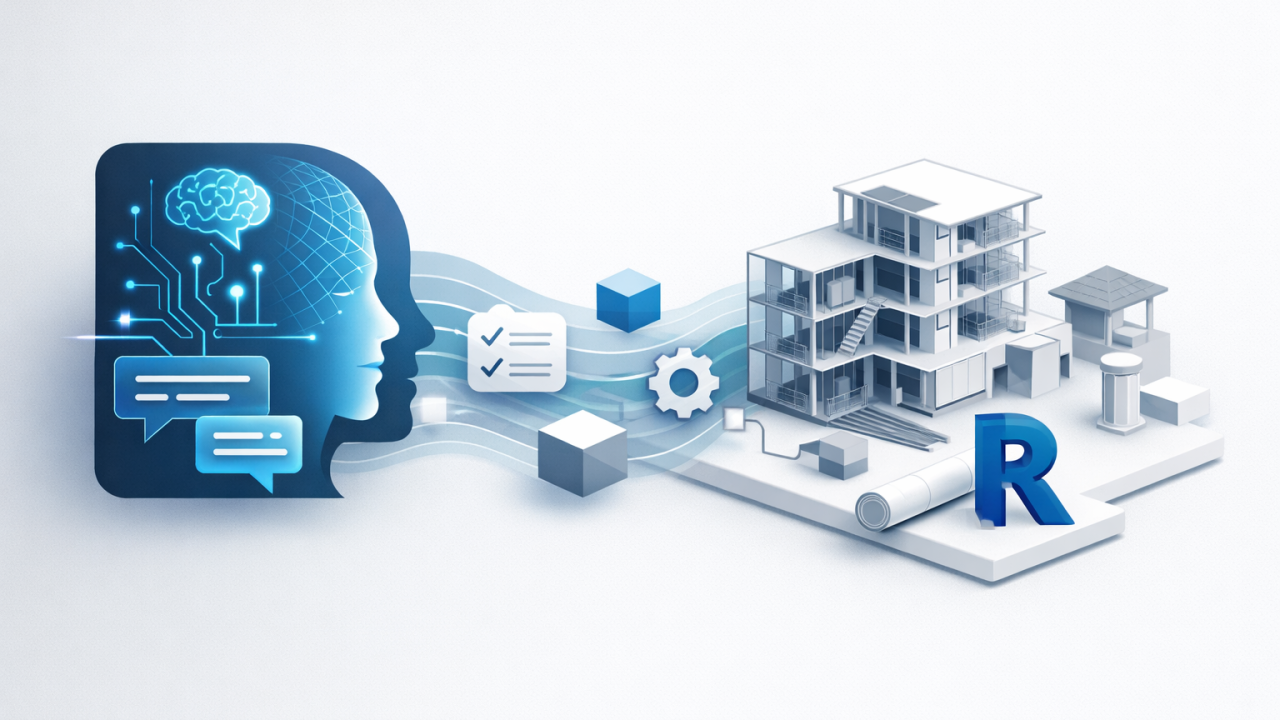
Authoring tools won’t be replaced. But the “front door” to those tools is shifting, from UI-driven commands to intent-driven conversation.
And no, I don’t think we’re headed for “design by chatting.” If you’ve ever tried to resolve a tricky stair condition, you know why. I do think we’re headed for authoring by intent, where language becomes the fastest way to invoke trusted workflows inside deterministic engines.
Why now? Three ingredients matured at once
This shift didn’t happen because someone slapped a chatbox into Revit and called it a revolution.
It’s happening because three things matured at the same time:
- language models got better at following instructions, less creative chaos, more usable precision
- tool calling went mainstream, structured actions, not just text
- vendors started standardizing how model context is exposed to AI, so assistants can see what matters and act safely
When those three converge, natural language stops being a novelty and starts becoming a practical automation layer.
The first wave is already here, copilots inside authoring tools
The earliest “AI in BIM” experiments were mostly search and support, help bots, knowledge retrieval, “what does this error mean?” assistants. Useful, sometimes even life-saving, but not transformative.
The new generation is different. These copilots sit inside, or alongside, your authoring environment and can do the work:
- generate schedules
- batch-edit parameters
- place views and sheets
- tag elements
- build repeatable documentation workflows
- run QA/QC checks and produce reports
A few patterns are emerging fast:
1) Documentation copilots
Tools like EvolveLAB’s Glyph CoPilot, and others in that category, aren’t trying to design for you. They’re doing the high-volume CD labor: tagging, dimensioning, sheet setup, the work that is essential and also wildly click-heavy.
The value isn’t AI creativity. It’s removing friction.
2) Prompt-to-command libraries
A pattern I think will spread is that prompts become reusable, shareable commands. BIMLOGIQ Copilot points in that direction, where teams can standardize a workflow, share it, audit it, and improve it over time.
That’s a big deal because it turns chat into something closer to an operational playbook.
3) Toolbox-first agents
Some vendors are leaning into reliability by giving the model a curated set of actions, read/select/edit/document, and forcing everything through those guardrails. NonicaTab represents that toolbox-first mentality, and products like Adarcus emphasize insights plus safer batch operations.
Different strategies. Same implication:
Natural language is becoming an interface layer over existing authoring engines, not a replacement for them.
Platform vendors are building highways, and standardizing connectors
The most important signal isn’t a single plugin.
It’s what the platforms are doing.
Autodesk, connectors, APIs, and governed action
Autodesk has been positioning its assistant as something that can connect to product APIs. More importantly, Autodesk has been talking openly about Model Context Protocol, MCP, servers, a standardized way for AI systems to access trusted tools and data, and take real actions through governed connectors.
Bentley, context-aware commands that can modify models
Bentley’s direction has similar DNA: copilots that understand context and can modify models based on natural language. OpenSite+ is explicitly marketing natural language and voice-activated commands for both querying and creation/modification.
Here’s the strategic takeaway I can’t unsee:
Vendors want AI to become a native workflow layer, integrated, permissioned, and safe enough for enterprise use.
And once platforms standardize access to actions and model context, differentiation moves up the stack:
Who can deliver reliable, domain-specific workflows that teams actually trust?
The technical shift, from chatbots to tool-using agents
A lot of AEC AI discussion still assumes a chatbot.
But the real shift is toward agents that can:
- understand context, active view, selection, levels, templates, standards
- call structured tools, get rooms, set parameters, place views, export schedules
- validate and report changes, transactions, diffs, logs
- iterate safely with the user, “I found 143 windows matching that rule, apply?”
In other words, less magic, more orchestration.
This is also why open-source projects around Revit and MCP have been popping up. The pattern is consistent: expose dozens of tools through structured calls so an AI client can query, modify, and create elements safely.
Even if you never deploy open-source in production, it teaches the core lesson:
Tool calling improves reliability. Governance becomes possible. Adoption becomes realistic.
What changes first, and what changes later
If you’re trying to predict where authoring is heading, separate near-term wins from long-term potential.
Near term, conversation becomes the fastest way to invoke repetitive workflows
In the next 12 to 24 months, the biggest impact will come from tasks that are:
- high frequency
- low ambiguity
- easy to validate
- reversible, undo/rollback
Translation, documentation and data operations.
- batch parameter edits and cleanup
- view/sheet generation and setup
- tagging/dimensioning workflows
- QA/QC checks, model health reporting
- standards enforcement, naming, templates, filters
This stage is about measurable wins. If an agent saves 30 to 60 minutes per day per user, it doesn’t need to be creative to be valuable.
Medium term, automating the automation
A huge step will be AI generating the tools we already rely on: Dynamo graphs, scripts, repeatable automations.
I’ve already seen examples where an assistant helps build a Dynamo workflow that then drives a Revit outcome, saving days compared to building it manually. That “AI builds the automation” pattern will become normal, especially as firms accumulate internal libraries.
Longer term, constrained authoring and spec-to-model workflows
Yes, generate a model from text will happen. But the earliest wins will be constrained:
- generate a model skeleton that follows an office template
- place a standardized kit-of-parts with rules
- update models as requirements change, “increase WWR on north façade, keep egress compliant”
- generate options, then keep the best ones as editable BIM
This isn’t free-form generative design.
It’s intent-driven configuration, where constraints and standards matter as much as geometry.
The destination is also cross-tool: intent to model to drawings to issues/RFIs to cost and schedule impacts, with one audit trail across systems.
What won’t change, and why AEC is not software
Here’s the hard truth: BIM/CAD work has a different risk profile than code.
- outputs carry liability and contractual implications
- errors can be subtle and surface downstream
- standards are often implicit, not encoded
- design intent is spatial and multi-disciplinary, the model is a negotiation, not just data
So no, natural language won’t replace professional judgment or visual authoring.
Humans will still own the decisions, especially in anything safety-critical.
The best implementations will make AI accountable: preview changes, explain reasoning, log actions, and keep humans in the loop.
A practical mental model, intent layers on top of execution engines
This is the cleanest way I’ve found to frame the next era:
- Revit/MicroStation/etc remain the deterministic execution engines
- natural language becomes the intent capture layer
- agents become workflow planners and orchestrators
- standards, templates, and firm knowledge become guardrails
- audit logs and diffs become the trust layer
In that world, the competitive advantage isn’t a chat box.
It’s the ability to reliably map intent to actions, across disciplines, across projects, across tool ecosystems.
How to prepare, without waiting for a perfect product
If you want to benefit from this shift now, you don’t need to bet the farm. You just need to get your foundation right:
- Strengthen standards and data hygiene Agents are only as good as the context you give them. Clean templates, consistent naming, reliable parameters equals dramatically better automation.
- Turn repeatable workflows into libraries The biggest ROI comes from standardizing routine work so it’s reusable, reviewable, and improvable.
- Start with low-risk, high-frequency tasks Documentation setup, QA/QC, reporting. Win trust before you chase magic.
- Demand auditability If an AI changes a model, you should see what changed, why, and how to undo it. Logs aren’t optional, they’re the product.
- Reframe the skill set The future BIM skill isn’t just prompting. It’s specifying intent clearly, validating results, and knowing what should never be automated without review.
Closing thought, authoring is becoming conversational, but not casual
I don’t think we’re heading toward design by chatting.
I do think we’re heading toward authoring by intent, where language is the fastest way to invoke workflows, interrogate models, and coordinate across tools.
Less time translating intent into clicks.
More time validating, deciding, and improving outcomes.