

Will Canada make its opening gambit in global infrastructure innovation through strategic government procurement and collaboration?
In the game of chess, white moves first and has the advantage. They set the tempo and direction of the game that translates into a real benefit for the outcome of the game. In the real world however, it is often the second mover that has the advantage. In new market opportunities or innovations, this is no fixed game with known outcomes, the first mover embraces the risk and uncertainty in trying something new, while the second mover can learn the lessons and reap the benefits.
The UK was that first mover in many areas of infrastructure innovation. The UK government made landmark investments in transforming its infrastructure delivery and operation. It led first of a kind transformation programmes that brought together industry and research to change infrastructure performance. The UK has reaped substantive rewards from its investment in infrastructure transformation, but the systems and approaches that it developed to implement them are entrenched. The second mover advantage awaits. Canada can adopt the best elements of UK policy and progress, but adapt to the lessons that it teaches to develop a world leading infrastructure transformation programme that realizes economic, social and environmental benefits far beyond any other nation.
This paper makes the case for federal and provincial leadership in infrastructure innovation within Canada. It gives an overview of the benefits that have been gained by the UK in its programmes, and the opportunities to adopt and adapt these approaches to a Canadian context. We examine and explain why infrastructure construction and operation productivity is in decline in Canada as well as around the world and why socioeconomic factors including an aging population requires the infrastructure sector to change how it operates to be fit for the future. Pedro Antunes Chief Economist likened this to using a shovel in construction compared to a backhoe. This example is apt, as despite the mechanization of construction, the sector remains little changed by technology.
Why has construction stayed the same?
Technology has penetrated every part of our lives. From aging to agriculture, we can live far longer and feed far more people than we could 500 years or 1000 years ago. The exponential growth of technology continues to disrupt and change whole businesses, sectors and countries. However, while the pyramids were being erected, as steam engines chugged by, one thing has not changed—the construction site. Around the world people still work in the same ways they did 10 years ago, a hundred years ago. The construction site is totemic for the built environment and infrastructure sector.
The Case of 3D Printed Houses
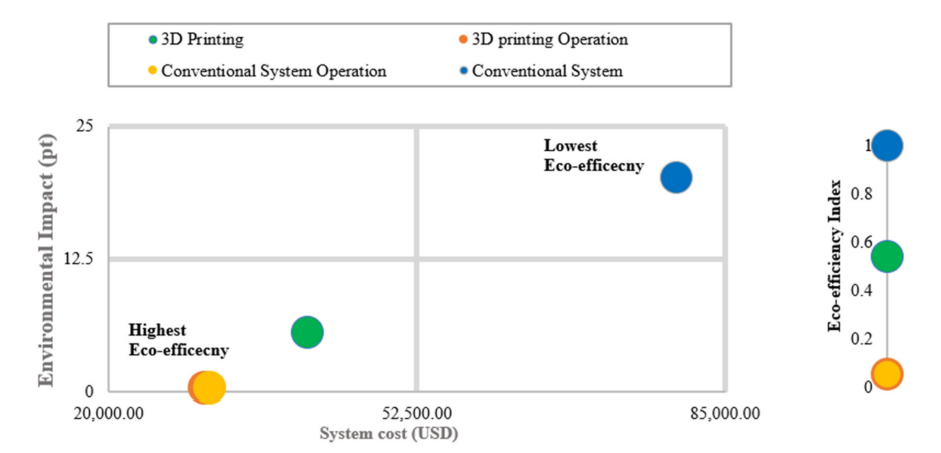
Let’s look at a concrete example of how technology has bypassed Canada’s infrastructure industry by turning our focus to 3D printing. There are 3D printers for houses that achieve a 78% reduction in the cost to build and have nearly half the CO2 impact. The buildings are made on time, they look amazing and they’re more sustainable.
The Problem with Procurement
So, why are only a few countries actively rolling out 3D printed housing? The answer is simple. In western countries the built environment does not reward innovation. While in areas like mobile phones there is clear market differentiation and products getting better year on year. The customers, largely governments, have not signalled any buying intention towards the infrastructure equivalent of a better camera, a larger screen or a longer battery life. In fact, the implementation of lowest cost tendering signals quite the opposite. Meanwhile, China has set a target for the building of 10 million affordable houses using 3D printing technology by 2025 which has kickstarted the industry.
The Experience Curve
New technologies always cost more at first. This applies not just to 3D printing buildings, but Cross Laminated Timber, BIM, Digital Twins, Off site manufacturing and Cyber Physical Infrastructure as well. However, these costs go down over time; this is not techno-optimism. It is the experience curve and it was a term first coined and proven by the Founder and CEO of Boston Consulting Group in 1973.
It proves that any new system will cost less over time, but it also shows that the initial costs of new systems are higher. The example given at the time was of the electricity production capability of steam turbine generators. As investment continued in the technology, costs sank.
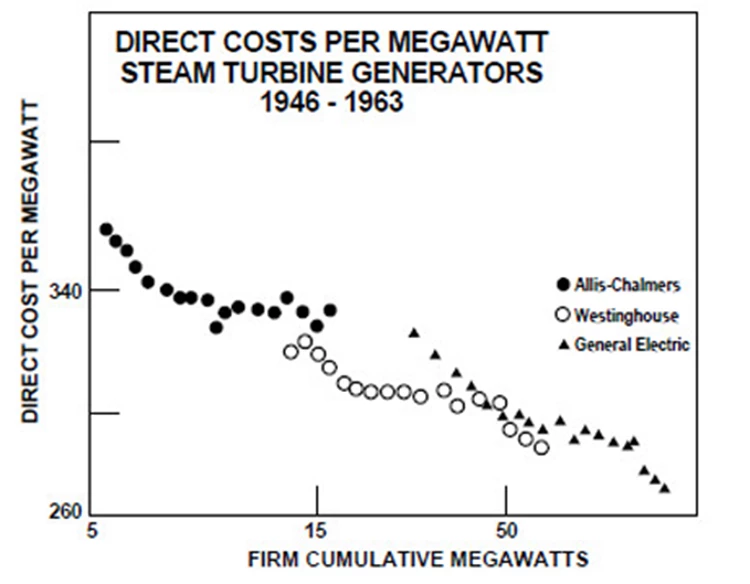
Confidential information from General Electric, Westinghouse and Allis-Chalmers made available in public records as the result of antitrust litigation.
The Carrot and The Stick
The carrot: Globally, infrastructure procurement and operation behaves in much the same way it did in the 1800s. As a result internationally the productivity of the sector has not increased. Costs continue to overrun, pollution continues to run rampant and smooth efficient operation is far from guaranteed.
The UK government, realizing that it has a significant stake in the infrastructure sector, pioneered a series of investment programs that have reshaped the built environment sector. From the inception of the Building Information Modeling (BIM) mandate to the Transforming Construction Challenge and the establishment of the Construction Innovation Hub and the Center for Digital Built Britain (CDBB).
These initiatives were able to develop and implement approaches that were taken up across the sector. They informed procurement processes that created better outcomes for the Government and gave those delivering infrastructure the opportunity to improve their businesses’ performance. The improvements enhanced the delivery of built assets in time, cost and quality, while also improving their environmental performance and whole life costs.
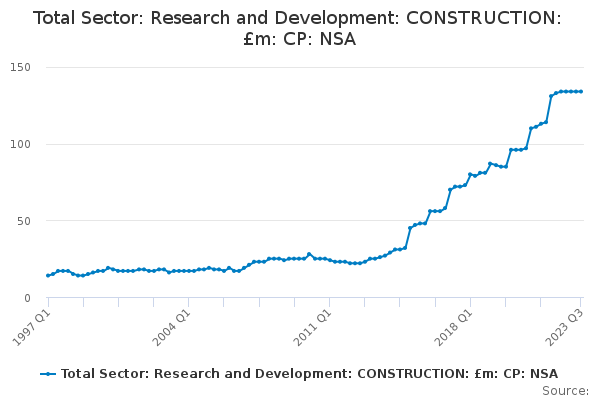
This kickstarted a cascade effect that has not been seen in infrastructure before anywhere, where previously organizations in the sector invested little in R&D. With the advent of the BIM Mandate, Transforming Construction Challenge and government leveraging procurement to enhance the quality of its infrastructure delivery, investment by the sector increased by 4.6 times.
The UK took a multifaceted approach:
- Developing an Innovation Ecosystem. Research Organizations, startups, investors, clients and the supply chain were brought together to collaborate.
- Leveraging central and regional spending power to drive improvement.
- Implementing an achievable target for the sector.
- Investing in centres of excellence and an R&D programme.
The stick: The UK government leveraged its ability to set targets and requirements on its own supply chain and thus implemented the BIM Mandate in 2012. Coupled with the investment that the government made as part of the Construction sector deal, this mandate required the implementation of BIM level 2 on all centrally procured capital projects.
Infrastructure Transformation in the UK
The UK government began the transformation of the construction and infrastructure sector in 2010 as it began to set out its vision for Building Information Modelling (BIM). A group of industry experts leveraged the lessons learned from the construction of London Heathrow Airport’s Terminal 5 building, the world’s busiest airport. A project of this scale meant that the small percentage allocated to innovation still amounted to a significant investment. The estimated savings of 10% contributed to the project being delivered on time and on budget. However, a significant factor in the success of this project was also the contractual innovation that took place. While the BIM approach used went on to drive the UK government’s mandate for a standardized approach to project collaboration, the implementation of the contractual model used has been variable.
Leveraging the power of public procurement to upskill the supply chain and provide better value for the assets of the national and regional governments is a reliable tool in the policy makers’ arsenal. However, without the collection of the relevant data figures for improvement while provable at the project level remain difficult to assess at the national level.
While the rest of the world was struggling with the implementation of BIM, the UK was requiring it for its capital investments. This drove change, and was formally instituted into the Centre for Digital Built Britain a University of Cambridge and UK Government collaboration. This transformation began with a group of advocates, but graduated to a much closer relationship between government, industry and research.
The UK has a well established mechanism for the government to provide funding for research organizations through UK Research and Innovation (UKRI). The UK government initiated the Transforming Construction Challenge. This wide ranging initiative, part of the Construction Sector deal, brought together contractors, supply chain, innovators, government, clients and the research community.
Its objectives:
- Projects delivered 50% faster
- Whole life costs reduced by 33%
- Lifetime emissions slashed by half
- Productivity raised by 15%
Three challenges provided focus and direction to the investment
- Moving to a manufacturing approach – from suppliers right through to site
- Embracing digital technologies to provide assurance, efficiency of projects and performance Feedback to design
- Shifting to selling outcomes (what a building does rather than what it is) and maximizing Whole-life value of assets
This programme moved infrastructure away from the cheapest cost to build and moved towards whole life value. This programme demonstrated nearly 30% improvements across the metrics measured, improving the number of construction projects delivered on time, with a lower cost per square metre and reduced labour hours required on site. Beyond the investment in achieving specific outcomes, this programme importantly kick started a cycle of innovation in the sector that has continued, resulting in not only a more productive sector, but one that is increasingly exporting these capabilities worldwide and creating standalone products that are being exploited globally.
Cyber Physical Infrastructure
At the Centre for Digital Built Britain we pioneered the Vision for Cyber Physical Infrastructure (CPI). This is the next evolution of all of the investments that have come before. CPI is the ability to make infrastructure safer, more reliable and adaptable to the individual citizen to achieve responsive infrastructure. Leveraging approaches and technologies including Digital Twins, AI and the Internet of Things, this is the revolution that is set to have the most impact. It is creating a network of virtual and physical infrastructure systems, the internet of infrastructure. Where before the most reliable forms of evidence for infrastructure performance for policy makers was either quarterly reports or the news, CPI will allow policy makers, infrastructure operators and citizens to see the performance of infrastructure in real time. This reduces closures and failures of key infrastructure, it optimizes travel times, reduces the operating costs of utilities while maintaining standards and creates the opportunity for infrastructure that can provide real time services to citizens. This spells the end for the empty bus sticking to the timetable, and the start of on demand infrastructure. This is termed Responsive Infrastructure.
Capability Development and the Innovation Ecosystem
To implement an infrastructure innovation programme that could truly revolutionize the way that Canada’s infrastructure is constructed and operated it is crucial to implement a policy framework that promotes seamless integration between technology, infrastructure, and the needs of stakeholders. This requires supportive regulations and incentives that encourage private sector engagement and foster public-private partnerships. Essential to this framework is the investment in both physical and digital infrastructure to facilitate innovation, such as broadband networks and data-sharing platforms.
By creating innovation hubs and regulatory sandboxes where new ideas can be safely explored and tested, the secondary economic and skills benefits of this investment can be realized regionally. The need to focus beyond single investments and instead championing cross-sector collaboration that maintains a flexible, data-driven approach enables policymakers to ensure that the innovation ecosystem is responsive to emerging needs and capable of sustaining long-term growth and adaptation for the country and its citizens.
The Key to Innovation Ecosystems
So, what exactly do we need to see happen in order to set up Canada’s Infrastructure industry for a checkmate?
- Interconnected: An effective innovation ecosystem creates seamless integration between different elements—infrastructure, technology, policy, and people. This should allow for the rapid development and implementation of innovations.
- Responsive: The ecosystem should be responsive to changes and needs, enabling real-time adaptation and updates in infrastructure and policy to efficiently meet new demands and challenges.
- Support for Innovation: There should be robust support mechanisms for innovators at all levels, from individual inventors to large corporations, including financial incentives, regulatory support, and access to necessary technologies and data.
- Cross-Sector Collaboration: The system should promote and facilitate cooperation across various sectors and disciplines to harness diverse expertise and resources, fostering a culture of shared goals and mutual benefits.
- Data-Driven and Evidence Led: Leveraging high-quality, accessible data to inform decision-making and innovation, ensuring that interventions are based on solid evidence and can be adapted as new information becomes available.
The Key Stakeholders of Innovation Ecosystems
- Government: At the federal and provincial level, the government acts as both regulator and facilitator, setting policies that encourage innovation while also providing funding and resources. With the implementation of Cyber Physical Infrastructure they will be able to monitor and adapt policy to meet the changing circumstances of infrastructure performance.
- Innovators:With the incentive to innovate created, innovators within large firms, government bodies and startups have increased scope to realize their potential. The innovation ecosystem creates a new marketplace for these actors, driving growth in the economy and adapting the market to the needs of an aging population.
- Research Organizations:Universities provide the underpinning expertise in research and development as well as many of the facilities for testing and proving the effectiveness of innovation. While they are inherently focussed on the quality of the process, their vast experience and range of expertise gives the ecosystem the tools it needs to improve.
- Infrastructure Owners and Operators: Those organizations managing and implementing infrastructure systems are able to increase the quality of service they provide to users, mitigate risks and increase their performance. They are a key stakeholder in identifying those areas that require improvement.
- Citizens: Infrastructure systems adapt to the needs of its users in real time. By moving beyond a flawed predictive statistical model of citizens’ needs towards a data centric and connected vision of infrastructure, citizens can be engaged in the optimisation of infrastructure systems based on their real needs and expectations.
The Infrastructure Innovation Investment
Adoption for an Innovation Ecosystem comes in two forms: Compliance and Capitalizing.
- Compliance: Establishing clear requirements for the performance of the infrastructure supply chain by setting up a legal and regulatory framework that supports and promotes innovation while protecting public interest sets clear expectations for the supply chain. By setting requirements that apply across the supply chain, the experience curve that accepts the initial cost of investment, but demonstrates the reducing costs over time is not imposed on any one actor in the market which would put them at a disadvantage for cost initially, but create market imbalance in their favour once the costs come down.
- Capitalizing: With well established mechanisms for innovation funding that overcomes the experience curve’s downside coupled with a strong relationship between governments, the market and research organizations investment in R&D with the inherent performance improvement follows. This attracts private investment, increases the ability for the market to compete internationally and gives better value for money to the government and ultimately the taxpayer.
In order to cultivate an ecosystem that allows for investing in innovation, we need to develop the necessary physical and digital infrastructure that enables it, such as broadband networks, research facilities, and platforms for data sharing. By fostering partnerships that encourage collaboration between the public sector, private enterprises, academia, and the community, we can create a multi-stakeholder approach that better aligns efforts and resources—leading to room for innovation. Implementing spaces where new ideas can be tested safely and where regulatory requirements are relaxed to encourage experimentation, will also be key to innovating. Of course, we will need to allow for constant adaptation (as the UK has done so well) maintaining a flexible approach that allows for the ecosystem to evolve based on lessons learned and changing circumstances, ensuring sustainability and relevance.
The UK’s Opening Move
The UK Government is a significant investor in infrastructure, it is able to leverage its influence to implement policies through procurement. This creates the driving force that mandates change and therefore creates the sea change necessary to implement transformative change to an entire sector.
Thanks to the work done by the UK investment programmes there is a closer relationship between industry and research than before. More startups are breaking out from academia into industry and this is enabling the productivity improvements that are necessary to tackle productivity, but also many of the government’s commitments around net zero, the labour market crisis and regional development.
However, it is worth noting that the targets set for Transforming Construction were met, but that the infrastructure sector globally is adroit at meeting its requirements as efficiently as possible. This is to say, that the way in which oversight was exercised would have been of a higher quality had the UK required more data from those investments it made to effectively measure success using evidence.
However, the UK did focus on outcomes rather than the latest trends. Where some countries simply required 3D models to be produced, the UK government has demonstrated its understanding that the way to drive change is through focussing on those benefits it is seeking to achieve. Productivity improvements and sustainability improvements are rarely achieved by the mandating of a specific technology as this forces the adoption of a technology or process that may only be best practice for a short period.
While it is certainly easiest to work with large companies to leverage their economies of scale, the majority of the construction and infrastructure sector in the UK consists of micro companies with fewer than ten people. The impact of the investments made by the UK government has made demonstrable improvements to the largest companies in the region, but a significant proportion of the work is done by smaller companies.
The Infrastructure Chess Game: Your Move Canada
In the strategic chess game of infrastructure innovation, the UK has made its opening move, setting a global precedent with pioneering initiatives. Now, Canada stands poised to capitalize on the second-mover advantage, where we can learn from the UK’s experiences and adapt strategies for enhanced outcomes. By initiating targeted pilot projects and fostering collaborations with enthusiastic participants, Canada can manage its early efforts more effectively than our predecessor. Adopting a platform approach and focusing on evidence-led decision-making, Canada is set to make its calculated second move in the global infrastructure chess game, aiming for enhanced productivity, sustainability, and cost-efficiency—but will we step up to the opening?
References
https://www.sciencedirect.com/science/article/abs/pii/S0378720623001520
https://www.skyquestt.com/report/3d-printed-houses-market
https://downloads.unido.org/ot/99/21/9921981/WP8.pdf
https://www.athenophilia.com/cyber-physical-infrastructure-review/